The total amount of digital data generated in the world (the global datasphere) was projected to reach roughly 180 zettabytes by 2025, and the quest for durable, high-density and sustainable storage is more critical than ever. Traditional technologies such as hard drives, magnetic tape and cloud servers are reaching their limits in density, longevity and sustainability. They are well suited to hot storage (fast, frequent, immediate access), but there is an unmet need for archival (cold) storage that is both economical and long-lasting.
A new frontier is emerging that combines molecular biology with optical encoding. DNA, a proven means in biology of encoding, preserving and transferring information over billions of years, is being explored as the basis for a viable archival storage technology.
In this article
- What is DNA data storage?
- Advantages of DNA data storage
- Key challenges: from concept to practical use
- Recent breakthrough: barcode-patterned DNA tape for fast, precise file management
- How the system works, step by step
- How does writing work?
- Where does the speed come from?
- Why this matters
- What stands between the DNA tape and commercial use?
- Conclusion: the road ahead
- Frequently asked questions
What is DNA data storage?
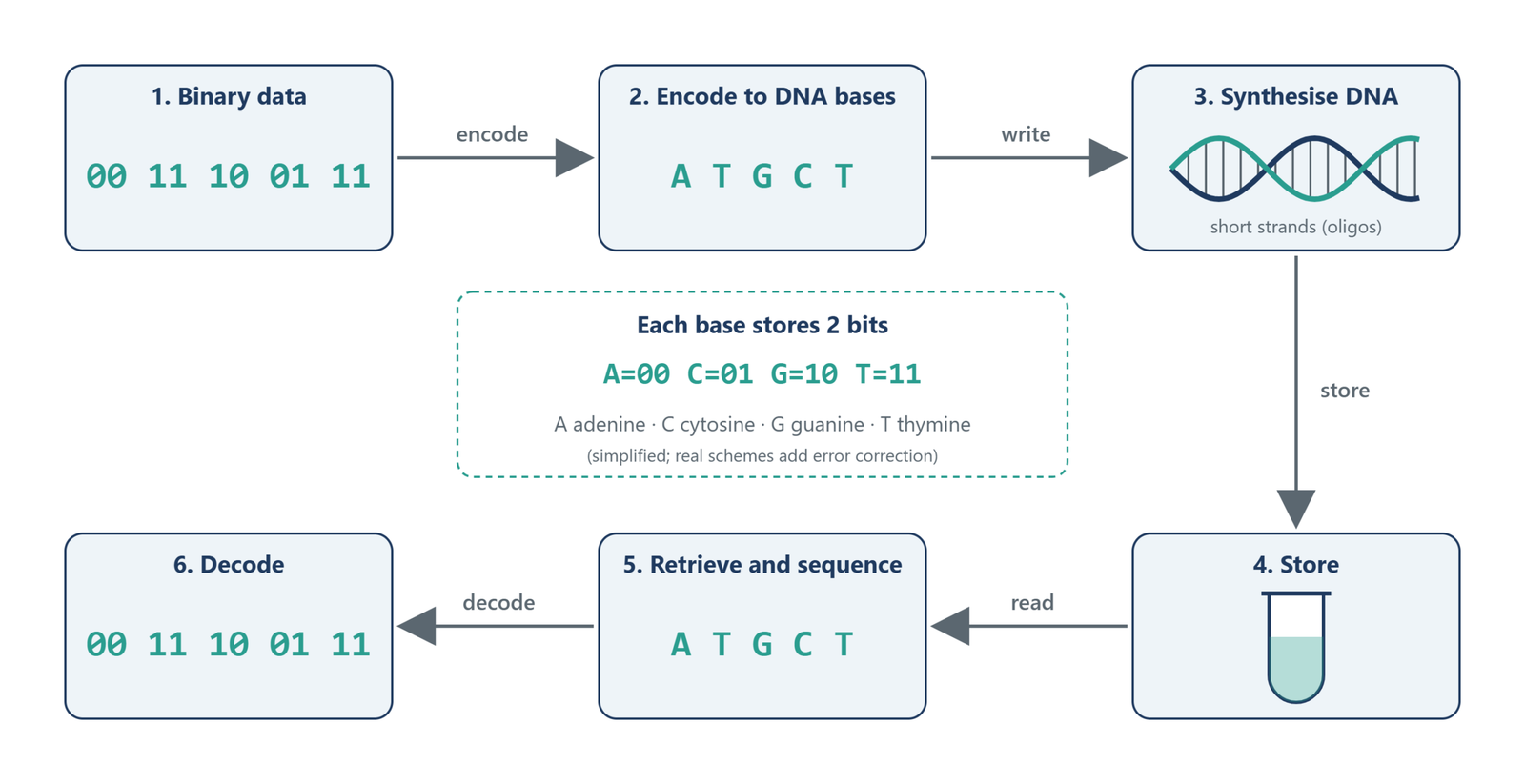
DNA, the blueprint of all living organisms, is a polymer built from four nucleotide bases: adenine (A), cytosine (C), guanine (G) and thymine (T). By translating binary data (0s and 1s) into sequences of these bases, one can “write” information into synthetic DNA strands. The strands can later be read back with DNA sequencing, recovering the stored data.
Because there are four bases, each one can represent two bits (A = 00, C = 01, G = 10, T = 11). By contrast, a memory cell in a solid-state drive (SSD) stores bits as voltage levels; a single-level cell, for example, holds one bit.
Advantages of DNA data storage
- Unmatched density. In theory, a single gram of DNA could hold up to 215 petabytes (215 million gigabytes) of information, far beyond any current technology (Science).
- Longevity. Under the right conditions DNA can last for thousands of years, making it ideal for long-term archiving of everything from scientific records to cultural heritage.
- Sustainability. Unlike energy-hungry data centres, DNA needs almost no energy once the data is written, which could shrink the environmental footprint of data archiving.
| HDD | SSD | DNA storage | |
|---|---|---|---|
| Data density (TB/in³) | 0.2 | 0.33 | 80,000 |
| Data retention (years) | 10 | 10 | 100 |
| Power when on (W/GB) | 0.04 | 2–8 / 3–10 / 0.5–3 | < 10−10 |
| Read–write speed (MB/s) | 30–150 | 500–7,000 | 20 |
Key challenges: from concept to practical use
Despite its promise, DNA data storage faces several technical and economic hurdles:
- Cost: synthesising and sequencing DNA is very expensive, though costs are falling quickly.
- Speed: writing and reading DNA is far slower than electronic methods.
- Error rates: synthesis and sequencing can introduce errors, making reliable retrieval a challenge.
- Scalability: moving from small demonstrations to terabytes or petabytes needs robust ways to manage large numbers of files.
Recent breakthrough: barcode-patterned DNA tape for fast, precise file management
Recent research from the Southern University of Science and Technology, China (Li et al., Science Advances) offers an elegant answer to one of the key challenges: how to efficiently address and retrieve thousands or millions of files stored in DNA. The answer borrows barcode patterns, familiar from packaging and logistics, to label and organise data partitions printed on a tape.
The work introduces a compact DNA cassette tape that works like magnetic tape but stores data in DNA. It packs over half a million data partitions per 1,000 m of tape and supports fast access and multiple file operations in under an hour. Protective coatings give long-term stability, and data can be written, stored and retrieved automatically. With DNA’s density and longevity, it is a potential game-changer for cold and warm data storage.
How the system works, step by step
Tape preparation and barcode patterning
- Laser inkjet printing creates barcode patterns (e.g. Code 128) along a polyester–nylon composite tape.
- Black ink and cross-linked PDMS printed in the barcode regions form hydrophobic barriers that act as physical partitions.
Data deposition (writing files)
- Data is encoded with the DNA Fountain algorithm and the DNA oligos are synthesised.
- Synthetic DNA is deposited in the hydrophilic “space” areas of the tape to represent data files.
- File information (folder names, file IDs) is encoded in the barcode patterns, making files addressable.
- A rotating tape and a simple mechanical “head” deposit DNA in specific regions efficiently.
File addressing and partitioning
- Barcodes generate addressable partitions.
- Files are assigned to specific “spaces” within barcode regions for precise location and retrieval.
Data retrieval (reading files)
- Optical sensors and barcode readers locate the target partition.
- The partition is soaked in NaOH to denature the DNA and release single strands.
- The DNA is sequenced to recover the data.
File removal and rewriting
- Restriction-enzyme cut sites in the DNA sequences allow precise file removal.
- New DNA can be deposited in the same or a different partition to rewrite or update data.
Micro-reactions and automation
- Enzymatic reactions (DNA removal, polymerisation, encapsulation) run in micro-reaction chambers on the tape.
- Motorised tape movement, simple mechanical heads and optical sensors automate deposition, retrieval and editing in a compact device.
How does writing work?
Data is written by depositing synthetic DNA into the “space” regions between the printed barcode stripes (hydrophobic black stripes separated by hydrophilic white spaces). DNA synthesis is needed to create the initial sequences, but the system does not synthesise new DNA for every update. Instead, files can be removed and redeposited through biochemical processes, allowing multiple write and rewrite cycles. For long-term or large-scale storage this reduces the need for continuous synthesis and makes writing more efficient.
Where does the speed come from?
Addressing uses a two-level barcode strategy. The tape carries continuous barcode patterns that create up to 5.45 × 10⁵ addressable partitions per 1,000 m. Primary addressing reads the barcodes to find the general area of a file at up to 1,570 partitions per second; secondary addressing then pinpoints the file within that partition in about 2 seconds.
A barcode reader based on a CMOS image sensor recognises barcodes at tape rotation speeds up to 2,400 rpm, giving a file-addressing rate of 1,570 files per second, about ten times faster than QR-code-based methods. Beyond cold storage, this opens the door to warmer, more frequently accessed storage too.
Why this matters
- Archiving: museums, libraries and governments could preserve priceless information for centuries.
- Big data: genomics, climate science and artificial intelligence generate massive datasets that DNA could store efficiently.
- Cultural heritage: DNA could safeguard humanity’s collective knowledge against disasters and technological obsolescence.
What stands between the DNA tape and commercial use?
Despite the advances Li et al. report, several barriers could slow commercial adoption:
1. Cost of production and implementation
- Some manual steps are gone, but high-quality DNA synthesis, barcode printing and reagents remain expensive. Commercial use needs further cost reductions.
- Encapsulation, decapsulation and sequencing can be costly, especially for large data volumes.
2. Engineering and scalability
- Moving from lab prototype to industrial systems means solving mass production, durability and reliability of the tape.
- Keeping tape fabrication, barcode quality and reaction fidelity consistent at scale is complex.
3. Data transfer speed versus conventional storage
- Addressing and recovery are fast, but overall transfer rates still lag SSDs and HDDs.
- Real-time or near-real-time applications will need faster reads and writes.
4. Long-term stability and error rates
- DNA is very stable, but storage conditions, degradation and sequencing errors could affect data integrity over decades.
- Error-correction schemes add complexity and cost.
5. Integration with existing data infrastructure
- Working alongside today’s storage and processing systems needs interfaces and standards for file management, encryption and data security.
Conclusion: the road ahead
DNA data storage is moving from science fiction to scientific reality. With ongoing research and innovations like this Science Advances paper, we are closer than ever to DNA archives that help meet the world’s data needs.
As costs fall and the technology improves, DNA could become the go-to solution for long-term, sustainable, ultra-dense storage. I wouldn’t be surprised if one day it is used for hot storage too.
Frequently asked questions
What is barcode-pattern DNA tape storage?
A data storage method that uses a tape patterned with barcode regions to precisely deposit, locate and retrieve DNA-encoded files. The barcodes create physical partitions and addressable regions, enabling high-density, automated data management.
How do the barcode patterns help?
They do two jobs: they form physical barriers that keep data in separate partitions, and they encode address information so optical readers can find and manipulate files accurately.
What is the tape made of?
A polyester–nylon composite film, with barcode patterns inkjet-printed in black ink and PDMS to create hydrophobic barriers.
How are files stored on the tape?
Synthetic DNA encoding the data is deposited in the hydrophilic “space” regions. Each file is associated with a unique barcode, which makes it precisely addressable.
How are files retrieved?
The tape passes under optical sensors and barcode readers to locate the file. The target partition is soaked in NaOH to denature the DNA, which is then sequenced to recover the data.
Can files be deleted or updated?
Yes. Restriction enzymes cut specific sequences to remove a file, and new DNA can be deposited in the same partition to update or rewrite it.
What advantages does it offer over traditional storage?
Ultrahigh density (potentially petabytes per kilometre of tape), automated operation, rapid deposition and retrieval, and long-term stability thanks to biochemical encapsulation.
How scalable is it?
A 1 km tape can hold over 500,000 addressable partitions, and capacity can grow further with more complex barcodes or partitioning schemes.
Is the system fully automated?
Not yet. Tape movement, optical file targeting and the micro-reactors for DNA deposition and removal are automated, but some preparation steps, such as DNA pool synthesis and barcode attachment, still need manual work. Faster DNA deposition may also require custom hardware beyond today’s commercial systems.
What improvements are possible?
More complex barcodes, better optical recognition, smarter micro-reactors and higher-density encoding formats could all increase capacity and access speed.
Further reading on DNA data storage
- Church, Gao & Kosuri, “Next-generation digital information storage in DNA”, Science (2012)
- IEEE paper on DNA-based storage
- Trends in Biotechnology review on DNA data storage
Your feedback
What do you think about DNA data storage? Could it change the way we preserve information? Send me a message with your thoughts, or suggest a topic you’d like decoded next.